May 12, 2025
Getting Started
From Discovery Call to First Sprint in Five Days
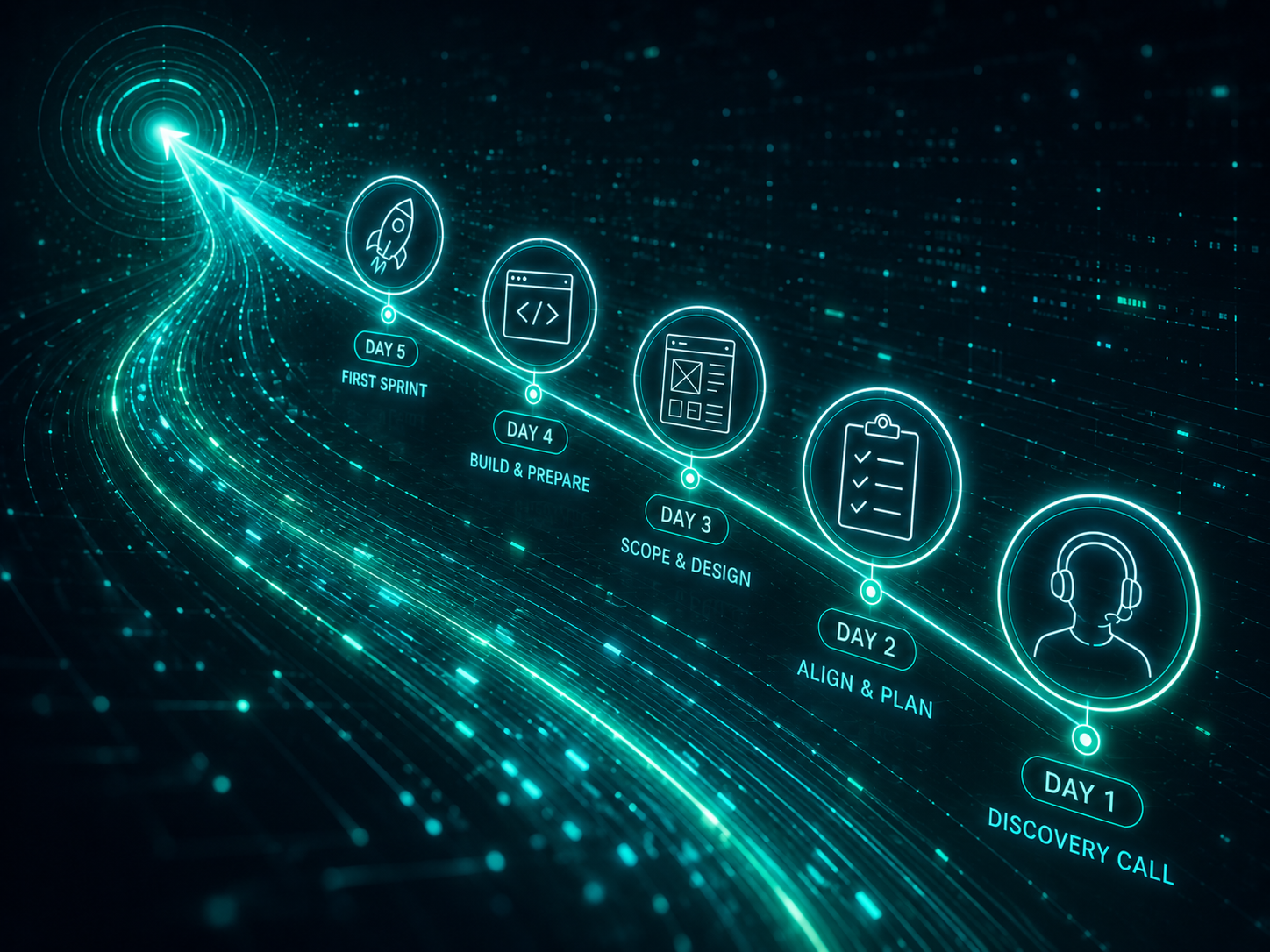
One of the most common complaints we hear from engineering leaders who have worked with agencies or freelance contractors before is that it takes weeks just to get started. Discovery workshops, statements of work, procurement processes, access provisioning. By the time anyone writes a line of code, three weeks have gone and the urgency has cooled. At Flare Labs we run from discovery call to first sprint in five days. Here is exactly what happens in that window.
Day 1: The discovery call
The 60-minute discovery call is the only meeting we need before work begins. We cover three things: the shape of your product, the current state of your codebase (if one exists), and what the most valuable thing we could ship in the next two weeks looks like. By the end of the call we will have told you whether a Flare Labs pod is the right fit. If it is, we move immediately.
There is no proposal document, no account management handover, and no "we'll come back to you next week." The lead engineer who ran the discovery call is the engineer who leads your pod. That continuity matters. They have heard you describe your product in your own words, and they carry that context into every architectural decision that follows.
The engineer who ran your discovery call is the engineer who leads your pod. No handover. No lost context.
Flare Labs
Days 2–3: Architecture review and playbook setup
Once access is granted, the lead engineer spends the first two days doing what a senior engineer is actually for: reading the codebase properly. Not skimming it. Understanding the data model, the deployment pipeline, the test coverage, the dependencies, and where the bodies are buried. This review produces two things: an honest assessment of technical risk shared directly with you, and the AI playbook for the pod.
The playbook is not a generic document. It is written for your stack, your patterns, and your quality bar. It specifies how the offshore developers should use Claude at each stage of their workflow: ticket decomposition, implementation, testing, and PR description. It also sets the review criteria the lead will apply to every commit. The pod does not write a line of production code until this document exists.
Day 4: Pod onboarding
The offshore developers are onboarded on day four. Because the playbook already exists and the architecture review is done, this is a fast process. They get access, they read the playbook, they attend a single kickoff call with the lead. Their first task is to ask questions, surfacing anything the playbook does not cover before the sprint begins. By end of day four they are in the tools, they understand the standards, and the first sprint backlog is broken down and prioritised.
Day 5: First sprint begins
On day five, the pod ships code. Not prototypes. Not spike branches. Production-quality code reviewed by the lead engineer before it is merged. The backlog you described in the discovery call is already partially closed. The AI playbook is running. The offshore developers know exactly what the standard is and how to meet it.
Five days is not fast for the sake of it. It is the natural pace when there is no internal hiring process, no procurement overhead, no ramp-up period spent waiting for access, and no discovery phase that exists mainly to justify a retainer. The pre-vetted pod, the reusable playbook framework, and the direct line from lead engineer to client remove every layer of friction that makes traditional agency onboarding slow.
2 Comments
Tom Ashworth
Day 5 being the day code actually ships to production is the bit that would've seemed impossible before reading this. We've been conditioned to accept that proper onboarding takes weeks. Curious whether the AI playbook framework is standardised across clients or genuinely bespoke each time. I assume it must vary quite a bit depending on the stack.
ReplyLeave a reply
Categories
Tags
Also Worth Reading
-
-
May 12, 2025
Ready to get started?
Book a 60-minute discovery call and we can have your pod running within the week.
Book a Discovery Call
Flare Labs is a UK-led engineering company pairing a senior British engineer with a high-performing offshore pod, delivering faster, leaner, and more accountable than traditional teams.
Get in Touch
-
- hello@flarelabs.dev
Rachel Morris
We went through a six-week agency onboarding process last year that involved three discovery workshops, a proposal revision cycle, and a handover from the sales team to a project manager who'd never spoken to us before. This describes a completely different world. The bit about the lead engineer who ran the discovery call being the same person who leads the pod is what stood out. That context continuity is almost impossible to achieve in the traditional model.
Reply